Mysterious Stone Sculpture Found

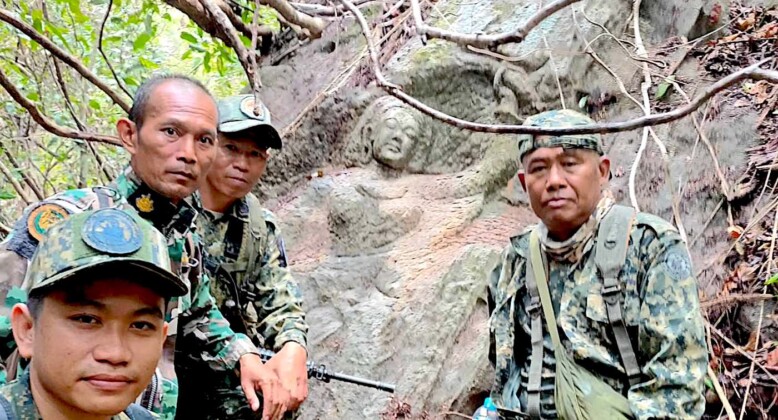
Three Thai villagers discovered a detailed boulder carving of a woman while searching for mushrooms.

“Found this while mushroom hunting,” wrote Pramul Kongkratok, one of the villagers, on social media. “I’ve lived here for so long but just learned we have this around here. It’s a blessing.”

Kongkratok reported the find to the Department of National Parks, Wildlife, and Plant Conservation, which contacted art and antiquities experts to determine the carving’s age.

Some suggest the carving dates back to the 6th century, possibly linked to the Dvaravati kingdom, located in modern-day Thailand near Cambodia. However, the carving style differs from known Dvaravati reliefs.

Another theory proposes that the carving represents Maya Devi, the mother of Lord Buddha, as the figure holds a branch of the Bodhi tree, under which Prince Siddharta Gautama attained Enlightenment. Despite this, depictions of Maya Devi are rare and usually show her lying down, leading to skepticism about this theory.

Artists during the golden age of Buddhist kingdoms in South Asia typically adhered to consistent carving styles, unlike this discovery. Additionally, a Thai Buddhist monastery with artistically inclined monks is located less than a mile from the site in Dong Yai Wildlife Sanctuary.

Regardless of its origin, the carving is a remarkable find and a reminder of the world’s hidden wonders.
Falling Into a Black Hole

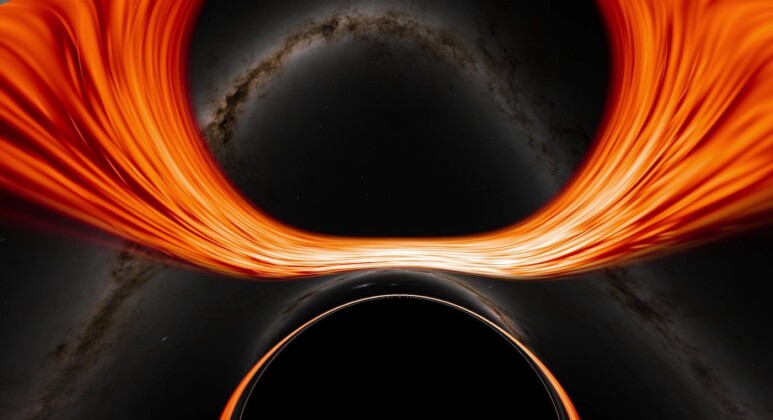
Using a supercomputer and the expertise of skilled scientists, NASA has created a video illustration showing what it might be like to float into a black hole if you were somehow invincible.

Within the event horizon of a black hole, the laws of general relativity break down, making it incredibly challenging to predict what would happen to an object. However, recent observations have provided insight into how light behaves near a black hole.

Several versions of the same simulation are explained in a 4-minute video released by NASA, providing visual aids for some extremely complex physics concepts.

“People often ask about [what it would be like to fall into a black hole] and simulating these difficult-to-imagine processes helps me connect the mathematics of relativity to actual consequences in the real universe,” said Jeremy Schnittman, an astrophysicist at NASA’s Goddard Space Flight Center in Greenbelt, Maryland, who created the visualizations. “So I simulated two different scenarios, one where a camera—a stand-in for a daring astronaut—just misses the event horizon and slingshots back out, and one where it crosses the boundary, sealing its fate.”

The video is more than just a visual treat; every feature corresponds with precise calculations that could have been published to great acclaim. The simulation targets a supermassive black hole like the one at the center of our galaxy. The camera was set 400 million miles from the 25 million mile-wide black hole. As it approaches, the hot disk of dust and gas swirling around the black hole, called an accretion disk, begins to elongate and brighten.

The project generated about 10 terabytes of data—equivalent to roughly half of the estimated text content in the Library of Congress—and took about five days, a task that would have taken a normal computer a decade.

Man Saves Forest

An Indian environmental activist has won the prestigious ‘Green Nobel’ for saving a 657 square-mile forest from 21 coal mines.

India faces frequent blackouts, affecting everyone from city residents to rural communities. The Modi government’s push for development and economic dominance has led to massive increases in power generation, including both solar and coal energy. India is a major coal consumer, and the Hasdeo Aranya forests, known as the “Lungs of Chhattisgarh,” are rich in coal deposits.

The state government was considering 21 coal mining projects across 445,000 acres of biodiverse forests that are crucial to 15,000 indigenous Adivasi people and numerous wildlife species, including tigers, elephants, and leopards. These forests, one of India’s largest intact habitats, faced destruction from 5.6 billion metric tons of mineable coal.

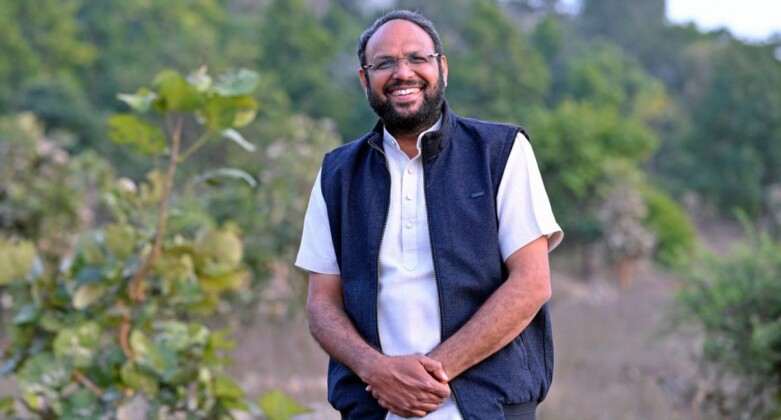
Alok Shukla, founder of the Save Hasdeo Aranya Resistance Committee, has spent a decade fighting to protect Hasdeo. His efforts included media campaigns, protests, and direct appeals to the legislature, emphasizing constitutional protections for tribal people and their environments.

Shukla proposed the creation of the Lemru elephant reserve within Hasdeo to protect migration corridors and cancel three mining proposals. This sparked a 160-mile protest march towards Raipur, the state capital. Midway through their march, they learned that the state legislature had unanimously agreed to protect the forest and cancel all mining proposals and existing licenses.

“We had no expectations, but the legislative assembly voted unanimously that all of the coal mines of Hasdeo should be canceled, and the forest should be saved,” Shukla recalled to the Goldman Prize media channel. “That was a very important and happy moment for all of us.”

Shukla shares the 2024 Goldman Environmental Prize with five other winners from Brazil, the US, South Africa, Australia, and Spain.

Type 2 Diabetes Cured by Stem Cells

Stem cells are increasingly being used in a variety of medical treatments, but a recent breakthrough from Shanghai suggests the best is yet to come.

A senior who had suffered from type-2 diabetes for 25 years hasn’t taken insulin for 33 months after receiving a regenerative islet cell transplantation.

Type-2 diabetes, often developed due to poor diet and lifestyle choices, is one of the most prevalent non-communicable diseases globally. China is particularly affected, with 140 million people suffering from diabetes-related complications such as kidney problems, blindness, amputation, and cardiovascular issues.

However, this new breakthrough, the result of 10 years of research and testing, might revolutionize the treatment of diabetes.

Yin Hao, a leading researcher and director of Shanghai Changzheng Hospital’s Organ Transplant Center, explained that they took the patient’s own peripheral blood mononuclear cells and reprogrammed them into pluripotent stem cells, which were then injected into the pancreas.

“Our technology has matured and it has pushed boundaries in the field of regenerative medicine for the treatment of diabetes,” Yin told China Daily. His team conducted the research with scientists from the Center for Molecular Cell Science at the Chinese Academy of Sciences.

Current transplant treatments for type-2 diabetes are limited by a shortage of donor cells and the complexity of pancreatic islet cell isolation technology. Pancreatic islet cells are the main insulin producers in the body, and the patient’s cells were almost completely inhibited. He relied on multiple daily insulin injections and had also undergone a kidney transplant.

After receiving the manufactured stem cells in 2021, he gradually stopped needing external insulin over 11 weeks, and his diabetes seemed largely cured.

“Follow-up examinations showed that the patient’s pancreatic islet function was effectively restored, and his renal function was within normal range,” Yin said. “Such results suggested that the treatment can avoid the progression of diabetic complications.”

The study was published in Cell Discovery on April 30th. Future research, the authors wrote, should explore pharmacological options that could provide off-the-shelf equivalents for islet transplantation.

Deep Sea Squid with ‘Headlights’

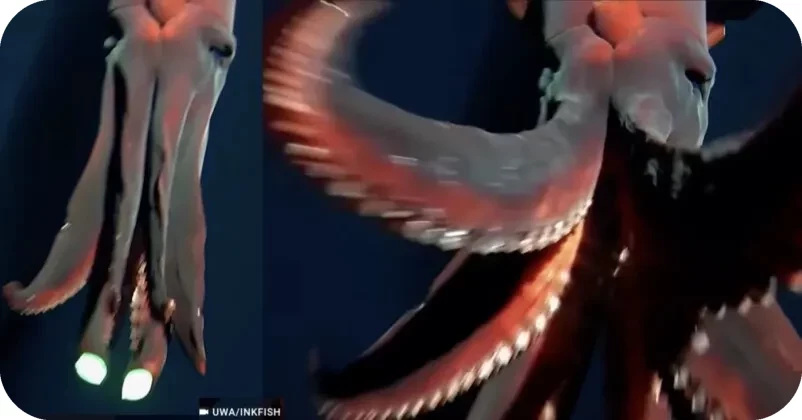
Australian marine biologists recently captured video footage of a large deep-sea squid attacking their camera over 3,000 feet below the ocean’s surface.

The deep-sea hooked squid, one of the largest species in its habitat, drew attention not for its size but for the glowing lights at the end of its tentacles.

A team from the University of Western Australia’s Deep Sea Research Center deployed baited, free-falling cameras to record deep-sea life.

Chief scientist Heather Stewart, working in the Samoan Passage, dropped the camera to a depth of 5 kilometers before retrieving it.

“We realized we had captured something very rare,” Stewart said, as they reviewed the footage.

They identified the squid as a Taningia danae, known for having the largest bioluminescent organs (photophores) of any known animal. These photophores are part of the squid’s hunting strategy, used to disorient prey with bright flashes of light.

“The squid, about 75 cm long, attacked our camera, mistaking it for prey, and tried to startle it with its bioluminescent lights,” Stewart added.

Professor Alan Jamieson, director of the Minderoo-UWA Deep Sea Research Center, noted the difficulty of observing deep-sea squid in their natural habitat.

“Most records of this species come from strandings, accidental bycatch, or the stomach contents of whales,” Jamieson said.

“Live observations of these squids are rare, making each encounter valuable for understanding their location, depth, and behavior. We had to share this unique sighting.”