Protecting Children from Smartphones


Smartphones are incredibly useful tools, but unfortunately, they can also have detrimental effects, especially on children and teenagers. Daisy Greenwell, an editor and writer at Positive.news, recently shared her experience of unintentionally sparking a significant movement from her kitchen to address these concerns.

The “Smartphone Free Childhood” movement gained unexpected momentum, initiated by Daisy and her friend Clare, two concerned parents troubled by the dilemmas associated with giving smartphones to children. They were particularly worried about the exposure of their children to potential harms such as pornography, cyberbullying, and social media-induced anxiety, weighed against the risk of social alienation for those without a smartphone. With increasing research showing a correlation between early smartphone use and higher rates of mental illness among the first generation of smartphone users, the founders felt a pressing need to act, spurred by the slow pace of regulatory measures to keep up with technological advances.

The movement began with a WhatsApp group named “Parents United for a Smartphone Free Childhood,” intended as a support network for parents opting to delay smartphone access for their children. What started as a modest, private group between two friends quickly exploded into a large community following a single Instagram post. The group swiftly reached WhatsApp’s membership limit of 1,023 participants, necessitating the creation of additional groups as more parents from across Britain joined the dialogue.

The founders, Daisy Greenwell, Clare Fernyhough, and Greenwell’s husband Joe, found themselves at the heart of an expanding movement, with their home transforming into an impromptu headquarters. The initiative has since grown nationally, with the formation of regional and school-specific WhatsApp groups throughout the UK. These groups provide a platform for parents to exchange experiences, offer support, and discuss strategies for promoting a smartphone-free childhood within their communities.

The initiative underscores the importance of utilizing simpler devices that provide basic communication functions without exposing children to the risks associated with fully featured smartphones. The movement also offers toolkits, developed in collaboration with experts, to aid discussions among parents and educators on this contentious issue, with the aim of shifting prevailing norms surrounding children’s smartphone usage.

The founders draw comparisons with historical changes in attitudes towards alcohol and smoking, suggesting that society will eventually reconsider its current approach to children’s smartphone use. Their objective is to protect the essence of childhood.

If you are interested, please check out Daisy’s original article. It is not very long and is a great story with good information. Most of you, our readers, are in the US not the UK, so joining one of these groups might not make sense. However, using them as a template could be a great idea if you find yourself in a similar position.


$182 Million Weekend – Dune: Part Two Review (No Spoilers)

I saw “Dune: Part Two” last week and I was not disappointed.

As both a sequel to the first part and as a movie on its own, it did excellently. The first thing to mention is the stunning cinematography and visuals. This along side the deep, booming, sound design and amazing score by Hans Zimmer brings such an impactful presence to the story, world, and characters.

Overall the acting was good. The set design was excellent. And they did a good job of taking a fairly long second half of the book and condensing it without sacrificing much of the story. They might have overdone the dramatic slo-mo entrances a bit, but they were still pretty cool.

Dune’s opening weekend had a Domestic box office of $82.5M and a International Box office of $100M bringing Dune to a very strong $182.5M box office total. That number is just shy of Dune: Part Two’s entire budget, which is estimated to be $190M. This is very impressive, particularly when compared to many recent action movies that have struggled or failed to recuperate their budget during their runs in the theater.

I normally do not like it when movies lack color and the saturation is turn way down leaving everything drab and dirty looking. However, it is not out of place in Dune, both because of the setting and because of the thematic elements of the books. Being a desert planet, it does not have many colors outside of shades of orange and yellow, which makes sense. Thematically, the books are on the darker side, so the color de-saturation did not seem out of place and I thought it was a good choice.

Like the first part it is a long movie, with a runtime of 2 hours and 46 minutes. However, they do a good job of not letting it drag. I noticed the length a little more than watching the first one, but I did not find myself getting bored or hoping it would end soon.

Were the movie faltered for me was with some of its deviation from the book. Particularly where it came to the character of Chani (played by actress Zendaya). Some of the movie’s general changes were understandable, and others quite necessary to insure a smooth pacing. However, when it came to the character of Chani, she felt somewhat out of place and was more in line with what you would expect from a teen action drama film or book from the 2010’s.

Despite my small criticism, the film was otherwise exemplary. I think it will be hard for anything else this year to top it and I would certainly recommend it!

If you like action, Sci-Fi, or just good films this is one you will probably not want to miss out on.

Carbon-Neutral Biofuels Within Reach

Researchers have developed a novel concept for a refinery that produces cost-effective and sustainable biofuels, along with valuable chemicals from non-food biomass like agricultural and forestry residues.

This innovation, aimed at addressing the high costs and ethical concerns associated with biofuels derived from food crops like corn and sugarcane, utilizes a straightforward pre-treatment process to convert complex plant materials into usable components.

Charles Cai, a professor of chemical and environmental engineering at the University of California Riverside, highlighted the dual achievements of this approach: “The key advance of our study is to demonstrate a biomass to biofuels and bioproducts strategy that can simultaneously achieve both economic viability and carbon neutral operation.” The research, published in Energy & Environmental Science, proposes a next-generation biorefinery capable of producing sustainable aviation fuels at competitive prices around $3.15 per gallon of gasoline equivalent.

The proposed refinery employs a co-solvent enhanced lignocellulosic fractionation (CELF) technique, initially introduced by Cai and his team in 2013. This process uses tetrahydrofuran (THF), a solvent derived from biomass, to effectively separate plant biomass into cellulose, hemicellulose, and lignin at relatively low temperatures. The CELF method facilitates the breakdown of plant matter into distinct streams rich in sugars and lignin, which can then be converted into fuel alcohols and specialty chemicals, respectively.

The economic and environmental feasibility of such a refinery was analyzed, focusing on the impact of various biomass feedstocks, the type of biofuel produced, and the management of lignin byproducts. Comparing two types of feedstock, corn stover and poplar wood, the study found that poplar, being richer in carbon and lignin, offers greater benefits.

Cai highlights the simplicity, affordability, and effectiveness of the CELF technology, noting its successful scale-up in trials and minimal variance in product composition. Backed by a $2 million grant from the Department of Energy, the team is now moving forward with plans to construct a pilot CELF plant at UC Riverside, marking a significant step towards realizing the potential of sustainable biofuels and bioproducts.

In summary, the carbon-neutral claim stems from the cycle of carbon absorption by biomass during its growth and the subsequent release of this carbon upon the biofuel’s utilization, thus not increasing the net amount of atmospheric carbon. Additionally, by leveraging waste materials and employing an efficient conversion process, the approach minimizes the environmental footprint associated with biofuel production, aligning with broader goals for sustainable and renewable energy sources.

Maybe we will not have to all switch over to electric cars after all! 😁

“Secret Code” Found Hidden in 1800s Dress

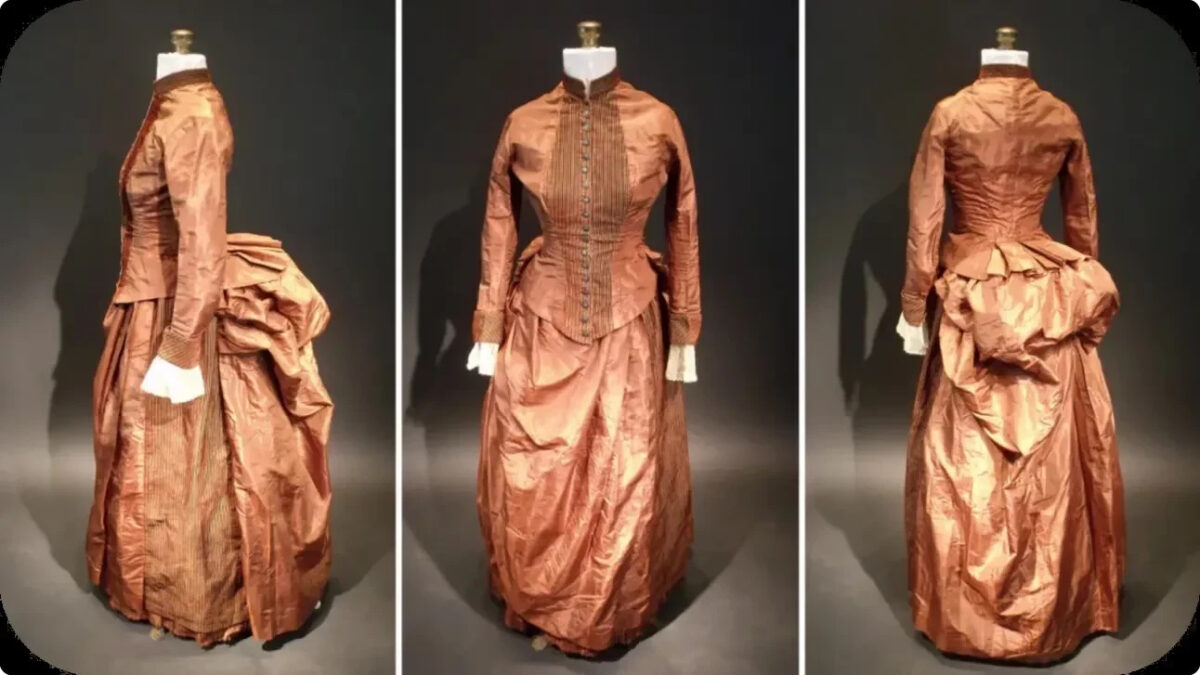
In an antique mall in Maine, Sara Rivers Cofield, a collector of vintage costumes and an archaeologist, discovered a Victorian dress from the 1880s. Despite its age, the dress’s intricate details and condition were remarkably preserved. The dress featured a secret pocket under its bustle, hiding two sheets of paper filled with a list of words and locations that seemed nonsensical or perhaps coded.

Rivers Cofield, intrigued by this find, sought to understand the purpose of these hidden messages and their significance to the owner, Bennett, who’s name was found hand written on a tag inside the dress.

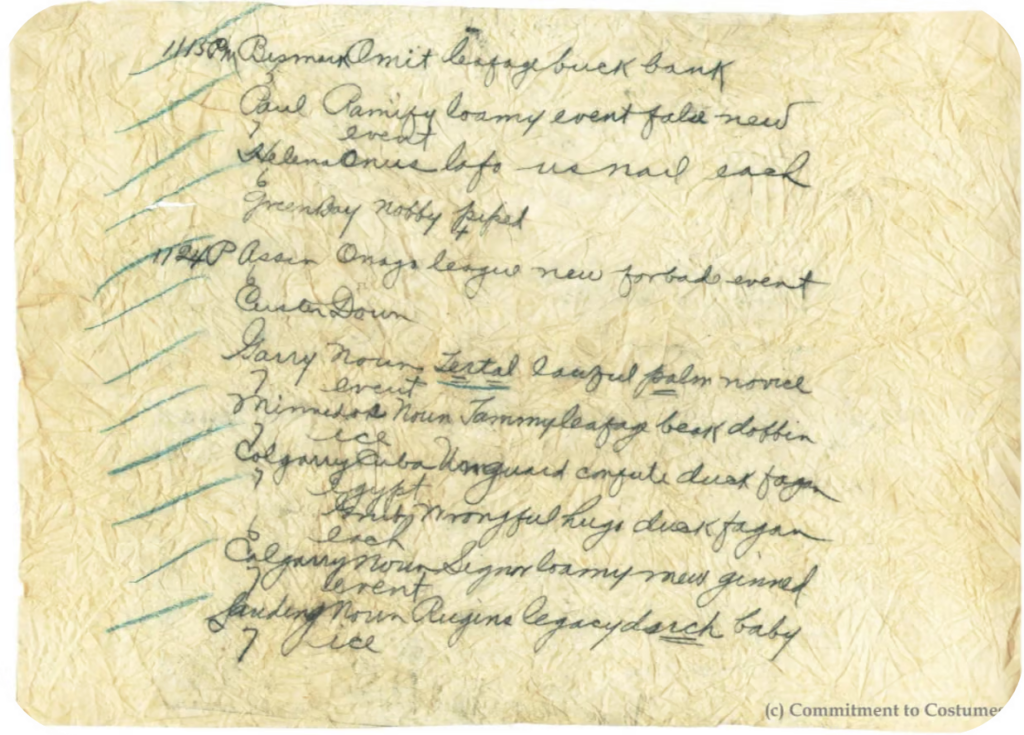
The code found within the Victorian dress’s hidden pocket consisted of a series of words and locations that, at first glance, appeared to be a random assortment. The cryptic list included terms such as “Bismark, omit, leafage, buck, bank” and another sequence mentioning “Calgary, Cuba, unguard, confute, duck, Fagan.” These sequences, coupled with marginal notes suggesting temporal elements, puzzled Sara Rivers Cofield and sparked widespread curiosity.

Cryptic note hidden inside 1880’s dress. Sara Rivers Cofield

In 2014, Rivers Cofield shared her discovery on a blog, hoping to attract someone capable of deciphering the cryptic notes. The mystery captivated online sleuths, though no conclusive answers were found. Speculation ranged from espionage to secret communications, but none fit the context of the dress’s era accurately.

The breakthrough came when Wayne Chan, a Canadian researcher, took an interest in the puzzle. Chan, experienced in solving codes, investigated extensively but initially found no solution. It wasn’t until years later, when he was exploring weather codes from the telegraph era that he identified the messages as weather reports. These reports were not encrypted for secrecy but rather condensed for economical telegraph transmission. Each word represented specific meteorological data, such as temperature, wind speed, and barometric pressure, relevant to a particular location and time.

For instance, the line “Bismark, omit, leafage, buck, bank” held detailed meteorological information:

“Bismark” indicated the location of the weather station, in this case, Bismarck, North Dakota.

“Omit” translated to an air temperature of 56 degrees Fahrenheit and a barometric pressure of 0.08 inches of mercury.

“Leafage” denoted a dew point of 32 degrees Fahrenheit observed at 10 p.m.

“Buck” signified the absence of precipitation.

“Bank” represented a wind velocity of 12 miles per hour and a clear sunset.

Chan’s research revealed that the coded messages followed a 19th-century telegraphic weather code used by the Army Signal Corps, the national weather service of the United States at the time. This discovery highlighted the practical use of telegraphic codes for cost-saving purposes in transmitting detailed weather information.

The complexity of the code, despite its non-secretive nature, shows the ingenuity of communication strategies in the telegraph era before they had all of our fancy cell phones.

AI Changes PDF Documents Forever

Adobe unveiled a new artificial intelligence assistant within its Reader and Acrobat applications, designed to streamline the process of summarizing and querying PDFs and other documents.

Currently in its beta phase, the AI assistant is accessible in Acrobat and is slated to be integrated into Reader in the near future, as per Adobe’s announcement. Following the beta, Adobe intends to offer a subscription model for this innovative tool.

This AI assistant aims to simplify the consumption of extensive PDF documents by providing concise summaries and responding to queries directly within the document, employing a “conversational interface” for ease of use. Furthermore, it is equipped to suggest potential inquiries users may have regarding the document’s content.

A standout feature of Adobe’s AI assistant is its ability to generate citations for its responses, ensuring users can trace the information back to its original source. Additionally, it can create text suited for various outputs, including emails, presentations, and reports.

While AI models like ChatGPT also offer PDF reading capabilities that facilitate the analysis of long documents, they necessitate uploading the PDF. Adobe sets itself apart by integrating this assistant directly into its applications, eliminating the need for external uploads.

Adobe CEO Shantanu Narayen, speaking with CNBC’s “Squawk on the Street,” highlighted the AI tool’s alignment with Adobe’s mission to “democratize access” to the vast array of PDF documents worldwide. Narayen envisioned a user-friendly experience where individuals can interact with, seek summaries from, and pose questions to a lengthy document, integrating this information with other documents and data across an enterprise.

Following the beta, Adobe intends to offer a subscription model for this innovative tool.