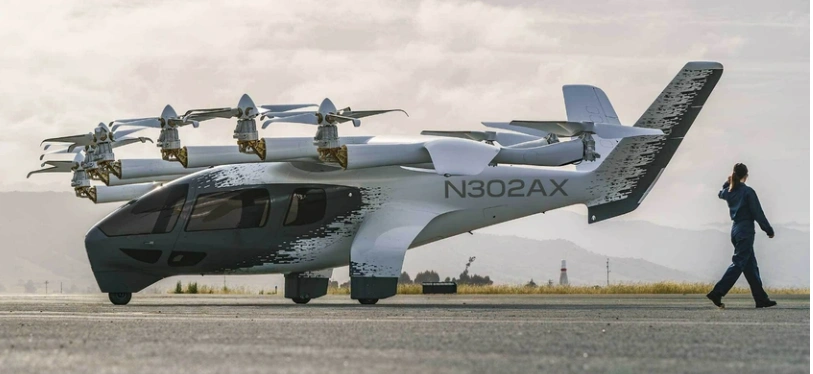
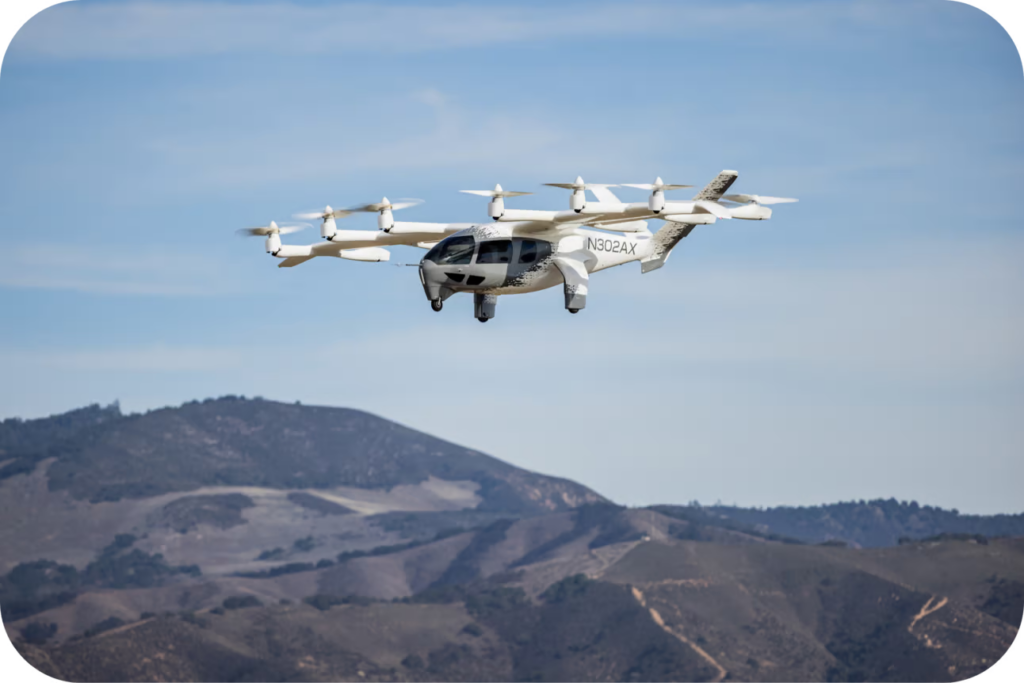
The Federal Aviation Administration (FAA) has granted Archer Aviation a crucial certification, moving the electric air taxi maker closer to flying travelers.
Archer is developing electric vertical takeoff and landing aircraft, or eVTOLs, and won orders and backing from United Airlines in 2021.
Airlines have been investing in or ordering eVTOL aircraft, which take off and land vertically like helicopters. For instance, United Airlines envisions passengers using them for trips to and from airports in major cities, such as between Manhattan and United’s hub in Newark, New Jersey.
“Today we have received the Part 135 certification, which allows us to effectively become an airline so we can carry passengers,” Archer CEO Adam Goldstein told CNBC.
The certification process took Archer about two years, during which they submitted over 2,000 pages of documents and 14 manuals outlining operational procedures, training, and maintenance.
Archer now needs to get its four-passenger aircraft, called “Midnight,” certified by the FAA. Goldstein mentioned that the company is currently working on this, with the possibility of air taxis entering service as early as next year. While he couldn’t provide an exact timeframe, he noted that Archer’s aircraft are much simpler with far fewer components than commercial jets, which might expedite the certification process.
Archer’s demonstrator aircraft, Maker, can fly up to 60 miles at top speeds of 150 mph. The company’s Midnight aircraft, the bigger of the two, has a range of 100 miles, although Archer plans to use it primarily for shorter distances.
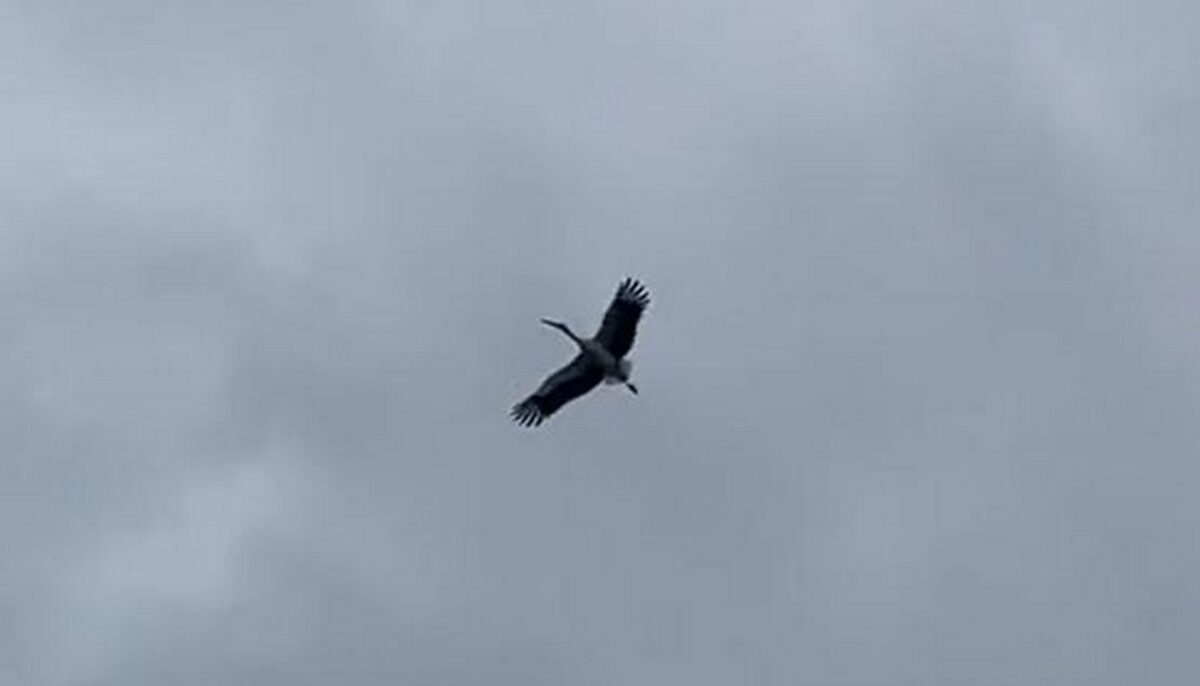
A white stork was recently spotted flying over Cheshire, England, marking an event not seen for generations. These birds have been extinct in England for 600 years, dating back to the time of Martin Luther’s reforms. However, they have been reintroduced and breeding in the country for several years due to conservation efforts.
The White Stork Project in southern England, supported by birds donated from the Warsaw Zoo, has played a key role in this reintroduction. The zoo’s storks had been rescued from accidents involving roads or powerlines.
Some of these storks are kept at the Cotswold Wildlife Park, and each year, their offspring are moved to the Knepp Estate and Wadhurst Park in Sussex. Here, they grow up in a natural environment, learning the skills needed to survive in the English countryside.
Cheshire is quite far from the Cotswolds and the Knepp Estate, where the reintroduction efforts are centered. “There are no plans to reintroduce them here in Cheshire, but it was great to see one this far north,” Banks added.
Despite their long absence in England, the white stork is classified as a species of least concern and can be found in regions such as Kenya, Palestine, Turkey, and Kazakhstan.
You can watch a live nest camera of a stork family at the Knepp Estate, courtesy of the White Stork Project, where juveniles can be seen competing for food brought by their parents.
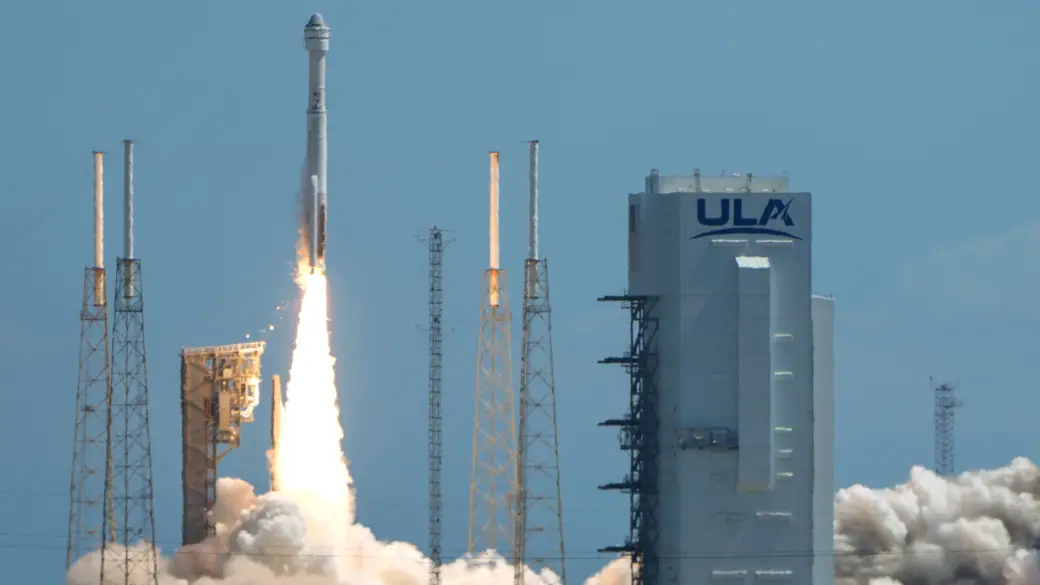
Boeing launched its first Starliner flight with astronauts last week, marking a critical final flight test of the long-delayed spacecraft.
The launch occurred at 10:52 a.m. ET from Cape Canaveral, Florida, with two NASA astronauts on board. The Starliner was carried by a United Launch Alliance (ULA) Atlas V rocket, destined for the International Space Station (ISS).
Approximately 15 minutes after liftoff, the rocket successfully released the Starliner capsule into orbit, with the flight proceeding as expected, according to mission control.
Although Starliner is equipped with cameras to capture views inside and outside the cabin, NASA’s broadcast indicated that Boeing would not be able to relay video footage back to Earth until the spacecraft reaches the ISS.
Starliner is set to travel in space for about 25 hours before docking with the ISS at 12:15 p.m. on Thursday. The astronauts will spend about a week on the ISS, focusing on testing Starliner, before returning to Earth.
Boeing’s crew flight test aims to certify the Starliner system as capable of transporting NASA astronauts to and from the ISS.
Wednesday’s liftoff followed a series of previous launch attempts. On Saturday, a launch was aborted in the final minutes of the countdown due to an issue with one of the ground support computers. Earlier in May, another attempt was canceled due to a detected problem with the rocket itself.
United Launch Alliance, a joint venture of Boeing and Lockheed Martin, replaced the rocket’s faulty valve after the May attempt and fixed a faulty part in the ground infrastructure computer after the Saturday attempt.
The Starliner capsule is designed to carry up to four NASA astronauts per flight, along with more than 200 pounds of research and cargo. The spacecraft lands using a parachute and airbag system and is reusable, with each capsule capable of flying up to 10 missions.
The Starliner capsule successfully docked with the International Space Station the next day, achieving a significant milestone for the company’s crew spacecraft in a crucial test flight.
Below is the video of the liftoff. The fun part starts around the 1 hour 10 minute mark.
I’m just glad all the doors were securely bolted on! 😬
Los Angeles based, Donn Delson began his aerial photography career nearly a decade ago. He has spent over 300 hours in helicopters, capturing scenes from the cherry blossoms of Japan to hidden mountain trails in the Red Sea—sometimes from 12,000 feet. He charters private helicopters, costing between $800 and $2,500 per hour, funded by his entrepreneurial success. After selling his company BandMerch, a leading entertainment merchandise business, Delson briefly retired before a holiday trip sparked a new passion.
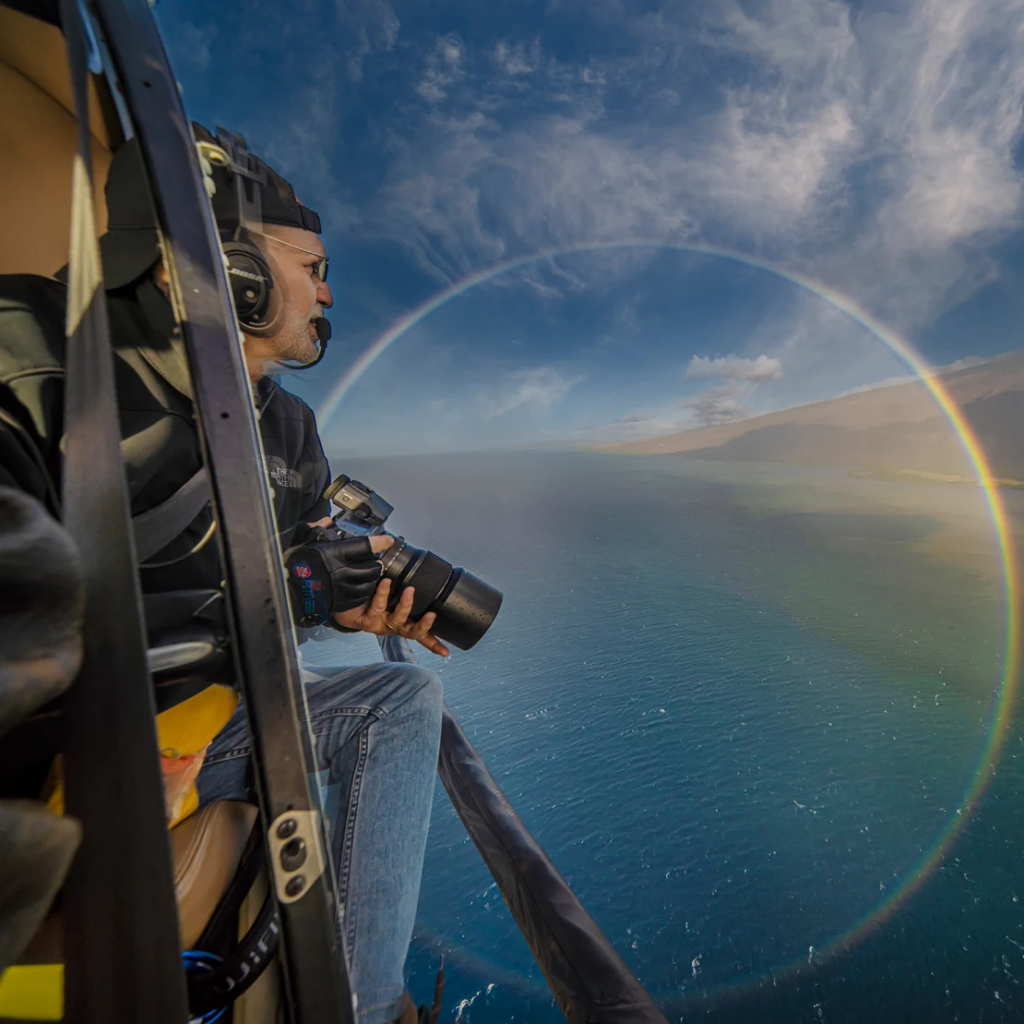
On a trip flying 3,200 feet over Molokai, Hawaii, Delson was captured inside a rare double circular rainbow. Courtesy Donn Delson
While many might balk at hanging out of a doorless helicopter, Delson prefers this setup—he won’t put his camera lens near a window. “It’s the only way I want to shoot,” he said back on the ground the next day, discussing his passion for aerial photography.
“I work on a large scale to convey the feeling I get up there.“The world from above is so different from what we know,” Delson said.
Earth’s magnetic field originates from swirling molten iron in its core, generating a dynamo effect. On Jupiter, however, the magnetic field is powered by an intriguing form of matter known as metallic hydrogen.
Jupiter’s massive size creates immense pressures deep within its core, producing exotic matter found nowhere else in the solar system. Hydrogen, typically a gas and the lightest element on the periodic table, is compressed within the planet until its electrons detach from the atoms and move freely. This sea of mobile electrons forms the dynamo that generates Jupiter’s powerful magnetic field. Jupiter’s magnetic sphere is the largest object in the solar system, several times wider than the sun. This vast magnetosphere shields the planet from solar winds, deflecting particles as far as Saturn’s orbit.
While Jupiter is protected from solar winds, the Jovian system—comprising Jupiter and its moons—produces its own energetic particles. These particles are trapped and accelerated by the very magnetic field that shields the planet from external ionic bombardment.
The charged particles originate from Jupiter’s most volatile moon, Io, whose volcanic eruptions become electrified as the magnetic field strips electrons from its molecules. These stray electrons zip around Jupiter at near light speed, releasing radio waves. From a scientific perspective, these radio emissions are problematic because they drown out radar signals used to probe the planet’s interior from Earth. Additionally, the electron shield creates a radiation belt that bombards visiting spacecraft. To mitigate this hazard, scientists had to build the probe that collected these readings “like an armored tank,”, according to Heidi Becker, a NASA planetary scientist and one of the 2017 Juno missions co-investigative leads. All the spacecrafts sensitive electronics were housed inside an electron-shielding titanium vault weighing almost 400 pounds.
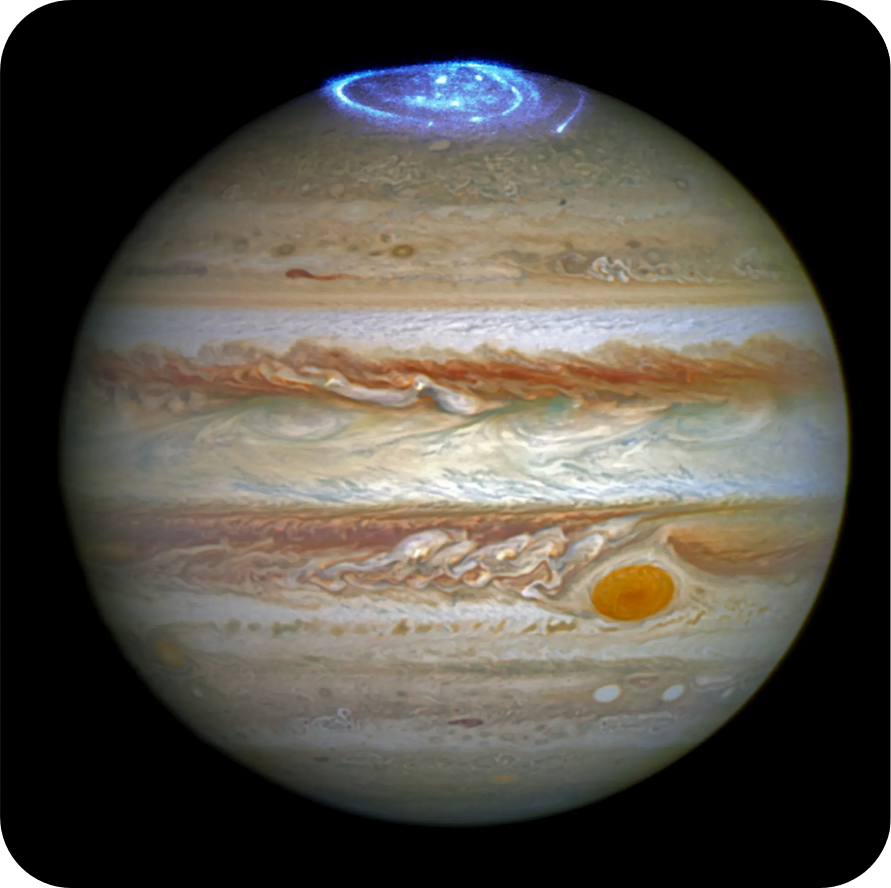
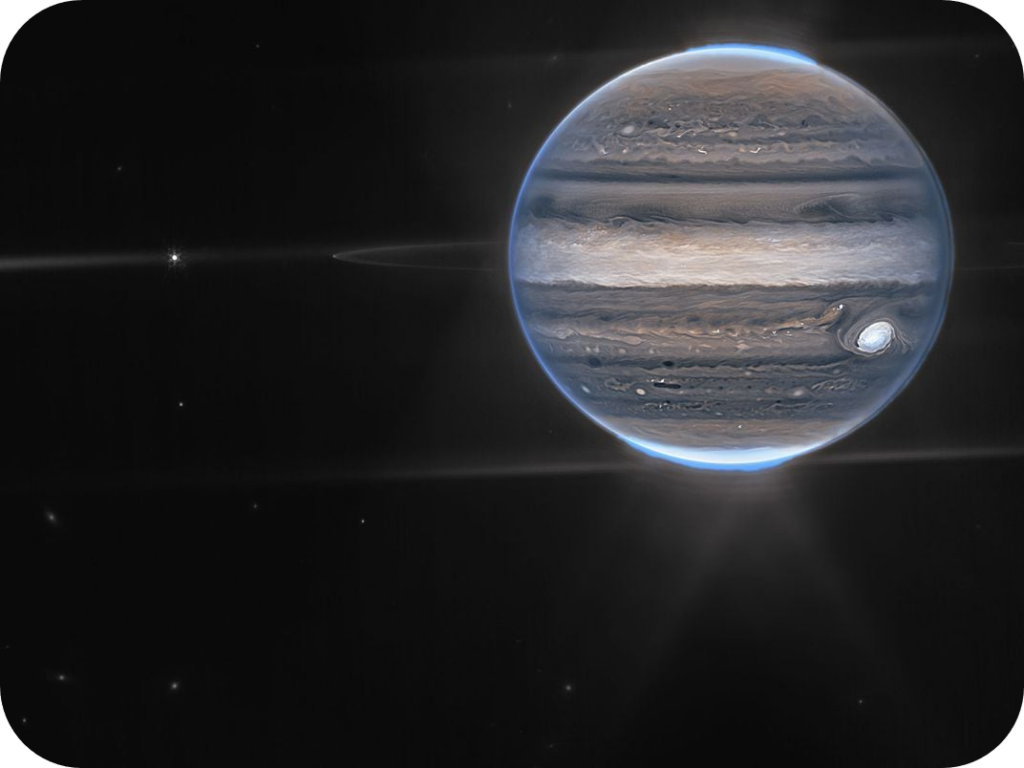
Despite the challenges, Jupiter’s powerful magnetosphere creates spectacular auroras when the electrons it directs collide with other atoms in the atmosphere, releasing bursts of light. Given that the magnetic field is large enough to envelop the moons, it also transports ejecta from Io to other locations. Scientists have detected contaminants as far away as Europa, another of Jupiter’s moons located hundreds of thousands of miles from Io.
Astronomers using NASA’s Hubble Space Telescope to capture stunning aurora in the planet’s atmosphere. NASA, ESA, and J. Nichols (University of Leicester)
Jupiter is Too Hot
Jupiter continues to radiate heat from its primordial days. This residual heat drives the intense storms that dominate Jupiter’s atmosphere.
The Voyager mission measured Jupiter’s heat output when it passed the gas giant in 1979. Scientists discovered that Jupiter emitted more heat than models had predicted, with some areas burning at nearly 800 degrees Fahrenheit above expectations.
Four decades later, scientists at the Keck Observatory resolved the mystery of Jupiter’s heat distribution. They mapped the planet’s temperatures, finding it coldest near the equator and hottest near the magnetic poles, where auroras flare most intensely. This revealed that auroras are an additional heat source. Plasma from Io’s volcanic eruption collides with Jupiter’s atmosphere to create spectacular auroras, and it interacts with Jupiter’s fast-moving winds, generating enough friction to raise global temperatures.
Also, did you know that Jupiter actually has a ring?
Jupiter’s ring consists of four faint subrings that float above the equator. Webb NIRCam composite image (two filters) of Jupiter system, unlabeled (top) and labeled (bottom) / NASA, ESA, CSA, Jupiter ERS Team; image processing by Ricardo Hueso (UPV/EHU) and Judy Schmidt CC By-SA 2.0