Dexcom has announced the clearance of its new over-the-counter continuous glucose monitor, Stelo, by the U.S. Food and Drug Administration. Stelo, which underwent FDA review in February, will be worn on the upper arm and has a lifespan of up to 15 days before replacement. This device will be available for online purchase starting this summer.
Continuous glucose monitors (CGMs) are small sensors that penetrate the skin to monitor glucose levels in real-time, primarily used by diabetes patients. Information from the sensor is transmitted wirelessly to a smartphone, aiding in the detection of emergencies for users, their families, and healthcare providers.
Stelo, Dexcom’s latest CGM, is specifically designed for Type 2 diabetes patients who do not require insulin. Notably, it is the first glucose biosensor that does not mandate a prescription, expanding accessibility, particularly for those without insurance coverage for CGMs.
With over 25 million Type 2 diabetes patients in the U.S. who do not use insulin, Dexcom aims to bridge the gap in accessibility. While their existing G7 CGM system serves this population, it necessitates a prescription, limiting its availability.
The FDA’s clearance reflects the significance of CGMs in managing blood glucose levels. Dr. Jeff Shuren, director of the FDA’s Center for Devices and Radiological Health, highlighted how this clearance facilitates individual access to CGMs without healthcare provider involvement.
Over the last two years, companies have been moving back to more in person work. As businesses called employees back to the office, they encountered an unexpected challenge: a significant number of employees seemed to have forgotten how to navigate the office environment appropriately. This phenomenon has prompted a notable surge in the demand for workplace etiquette training, reflecting a critical adaptation to the hybrid work era.
A survey conducted by Resume Builder in July, encompassing over 1,500 business leaders, revealed that more than 60% of companies are planning to introduce or have already implemented etiquette courses for their staff this year. The profound impact the pandemic had on professional conduct has reaffirmed the idea that soft skills are indispensable for maintaining a productive and harmonious workplace.
The transition to remote work led to the blurring of professional boundaries. As employees adapted to working from home, habits and behaviors suited to a more private and informal setting inadvertently crept into the professional sphere. Michael Chertoff, a spokesperson for the necessity of reacclimating to office norms, captured the essence of the issue: “It’s like people just got out of practice in some ways…So, you have to learn and remember that, no, you have to wash your dish because you’re not at home, you’re at the office.”
Common etiquette missteps observed include inappropriate volume control during phone conversations, leaving communal areas untidy, engaging in unsuitable office discussions, awkward social interactions, and communication pitfalls such as overly lengthy emails or the misuse of emojis and acronyms with ambiguous interpretations. Additionally, the nuances of dressing appropriately for the office and virtual meetings pose a challenge, with Chertoff advising against overly casual attire (even for the lower half in case you have to hop up to grab something).
Because of this, office etiquette guidance has proliferated across social media platforms, with influencers and professionals sharing tips and insights.
Of particular concern is the integration of Generation Z into the workforce. Many in this demographic entered their professional lives amidst the pandemic, missing critical opportunities for in-person learning and internships. Consequently, they face unique challenges in adapting to office norms and expectations. Addressing this, some academic institutions have begun to emphasize the importance of soft skills alongside technical proficiency, incorporating courses on professional behavior, networking, and business etiquette into their curricula.
Understanding and navigating the complexities of modern workplace etiquette is not only about preserving decorum but also about ensuring effective collaboration, mutual respect, and the overall success of the organization. As Chertoff succinctly puts it, “Soft skills are just as important or more important than the technical skills that you learn.”
Luckily, it looks like the etiquette courses and Tik-Tok influencers have got Gen Z covered. Best of luck to them!
A family from Northern California experienced a harrowing incident when their plane was forced to make an emergency crash landing in Mendocino County’s wooded area earlier this month due to engine failure.
The Mendocino County Sheriff’s Office reported that the family, consisting of a man, a woman, and their 2-year-old child from Santa Rosa, had just departed from Shelter Cove Airport, which is located approximately 170 miles northwest of their hometown.
Shortly after takeoff, the aircraft, a single-engine plane, encountered a critical loss of power, leading to a rapid descent. In a swift decision by the pilot, a parachute system was deployed, which significantly slowed the descent, allowing for a relatively soft crash-landing in the woods.
Miraculously, all passengers emerged from the ordeal with only minor injuries.
Despite extensive research and discussions on the topic for decades, the United States still lacks true high-speed rail services. Since the late 1980s, there have been efforts to introduce bullet train service in Texas, with Texas Central spearheading the most ambitious project since 2014. This project aims to connect Dallas and Houston with a train capable of speeds over 200 miles per hour, significantly reducing the current three-and-a-half-hour drive to just 90 minutes.
Andy Byford, Amtrak’s senior vice president of high-speed rail programs, emphasized the advantage over conventional travel methods, saying, “You cannot do that in a car. You cannot do that if you fly, if you factor in going to the airport, going through security, getting back in from the airport at the other end.”
In 2023, Amtrak sought to rekindle the high-speed rail project within the Texas Triangle, aiming to enhance connectivity between Dallas-Fort Worth and Houston, which are among the nation’s largest population centers.
The debate over high-speed rail accompanies broader transportation challenges, with alternatives such as expanding airports or highways failing to significantly reduce travel times. Congressman Seth Moulton, formerly associated with Texas Central, articulated this dilemma, stating, “If you don’t build high-speed rail between Dallas and Houston, then you only have two options. You can either expand the airport or expand the highway. It’s not going to decrease the travel time between those cities. It’s still going to take at least three hours to get between Dallas and Houston.”
Despite the clear benefits, the project does have several drawbacks, including regulatory and property rights issues. Financially, the endeavor is daunting, with an estimated cost of $33.6 billion. High-speed rail projects globally, like Japan’s Tokaido Shinkansen, have faced cost overruns, raising questions about economic feasibility. However, the project has attracted significant support, including a $300 million loan from the Japan Bank for International Cooperation and a study grant for potential Amtrak partnership.
If satisfactory solutions are found for these problems, high-speed passenger rail could be a huge positive for those living in the area.
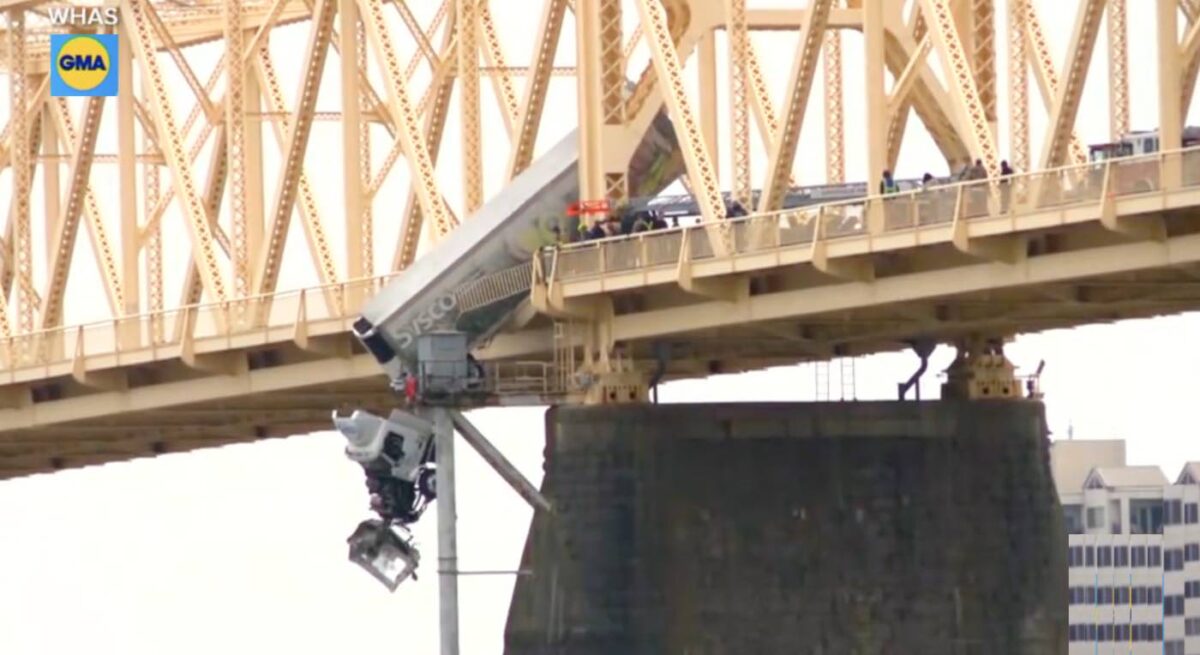
Last week in downtown Louisville, Kentucky, a heart-stopping incident occurred on the Clark Memorial Bridge when a semi-tractor trailer was left teetering on the edge, almost falling into the water below. The Louisville Fire Department responded swiftly, arriving on the scene within minutes to address the precarious situation.
Fire Chief Brian O’Neill highlighted the rescue operation, which was swiftly executed using a technique known as a ‘pickoff.’ Firefighter Bryce Carden played a crucial role in the rescue, being lowered by harness to reach the driver, who was secured in the cab by her seatbelt. The teamwork and precision of the rescue effort ensured that the driver was safely extracted and back on solid ground in less than 40 minutes.
The Louisville Fire Department’s quick and effective response earned widespread praise. “The first responders did an amazing job,” the department stated on social media, emphasizing the collective effort behind the successful rescue. Fire Chief O’Neill expressed his pride in the team, acknowledging their constant training for such scenarios as pivotal in the operation’s success.
This event was not just a showcase of the fire department’s dedication and skill but also highlighted the miraculous circumstances under which the truck was caught by the bridge’s structure, preventing a potentially tragic outcome. Firefighter Carden, reflecting on the incident to GMA, noted the extraordinary luck involved, stating, “She is incredibly fortunate that the semi truck threaded the needle of those bridge stanchions…getting wedged in there.”
The bravery and expertise of the Louisville Fire Department’s first responders turned a potentially tragic situation into a testament to the value of preparedness and teamwork.
Check out a longer video here as well as an short interview with the firefighter.