College Lab Makes 3D Printed Arms

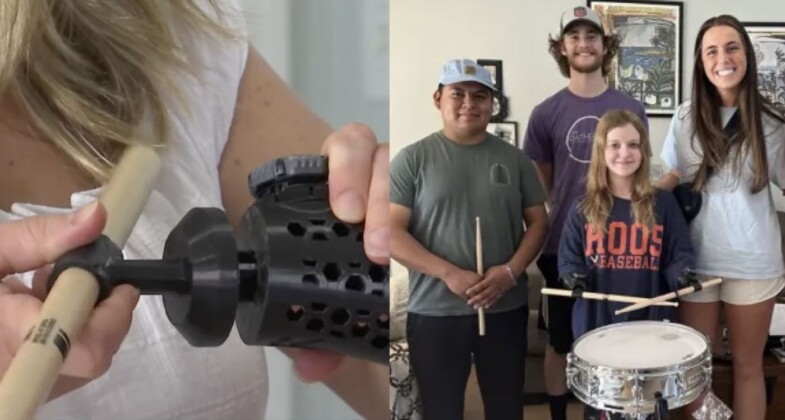
12-year-old Aubrey Sauvie never let her lack of hands stop her from pursuing Tae Kwon Do, art, or doing her own makeup.

Born a triple congenital amputee and missing both arms from below the elbows and several toes on one foot, Aubrey quickly showed her family she didn’t need much accommodation. “It’s just one part of me,” Aubrey told WKRN. “It doesn’t define me. Learning was a challenge, but over time it became easier.”

Aubrey’s family album is full of pictures of her in dance competitions, breaking boards with a flying side-kick, and playing snare drum in her school band with drumsticks in her elbow creases. But playing the snare didn’t produce the sound she wanted. Her middle school band teacher suggested she join the Tennessee Tech University program, Engineering for Kids, where 10 students made it their project to create custom prosthetics for her to play the drums.

The students designed a 3D-printed pair of durable, flexible prosthetics with interchangeable grips. Tennessee Tech Professor of Mechanical Engineering Stephen Canfield called it a one-in-a-million shot. The students spent the semester taking measurements and testing prototypes. Their hard work paid off, surprising them and delighting Aubrey.

Now, Aubrey enjoys the proper snap of a snare hit and dreams of playing a full drum kit.

US Crime Rate Has Historic Drop

The FBI released its latest Uniform Crime Reporting survey recently, revealing a significant positive trend across the US, with both violent and property crimes dropping by double digits.

Data from the first quarter of 2024 shows that reported violent crime decreased by 15.2 percent compared to the same period in 2023.

Specifically, murder rates fell by over 26 percent, rape incidents decreased by 25.7 percent, robbery cases dropped by 17.8 percent, and aggravated assault reports went down by 12.5 percent.

Property crime also saw a decline, with a reduction of just over 15 percent.

The report includes data from more than 18,000 law enforcement agencies at the city, county, state, tribal, university and college, and federal levels.

This is a pretty incredible drop in crime. It is a good thing to see after the crime spikes of the last couple years. It is too easy to be sucked into the negative, main-stream news cycle. I think it is always important that we take note when things get better. That is what we are trying to do here at Daily Upsider.

The 20 Billion Dollar Shipwreck Treasure

Among history’s many shipwrecks, the San José galleon stands out for its treasures, estimated at $20 billion in gold, silver, and emeralds lying at the bottom of the Caribbean Sea. Dubbed the “holy grail” of shipwrecks, its riches have led to prolonged ownership disputes.

Recent developments include a pledge by the Colombian government to retrieve parts of the ship and its goods. In 2022, new images from a remotely operated vehicle revealed valuable items like gold ingots, coins, and pottery. Earlier this year, Colombia announced a $4.5 million recovery effort using a robot to salvage artifacts from 2,000 feet below the ocean’s surface.

The San José was a Spanish galleon equipped with 64 guns and three masts, launched in 1698. On June 8, 1708, it encountered a British squadron near Isla de Barú, south of Cartagena. While its sister ship, the San Joaquín, escaped, the San José was attacked and sank after an explosion, taking its treasures with it. Only 11 of its 600 passengers survived.

Today, the San José is at the center of a new battle over its fortune. Claimants include the governments of Colombia, Spain, and Peru, the U.S. company Sea Search Armada (SSA), and the indigenous Qhara Qhara people of Bolivia. The most intense legal friction is between Colombia and SSA, which claims to have found the wreckage in 1981. The Supreme Court of Colombia ruled in 2007 that items of “national cultural patrimony” belong to Colombia, with other items split between the parties. In 2015, Colombia announced it had found the true location of the shipwreck, rejecting SSA’s earlier discovery. SSA maintains that the debris found in 1981 is linked to the 2015 site and is suing Colombia for $10 billion.

While the San José’s treasure garners much attention, protecting cultural items seems to be a priority for the Colombian government and its partners.

Dodging Vampires

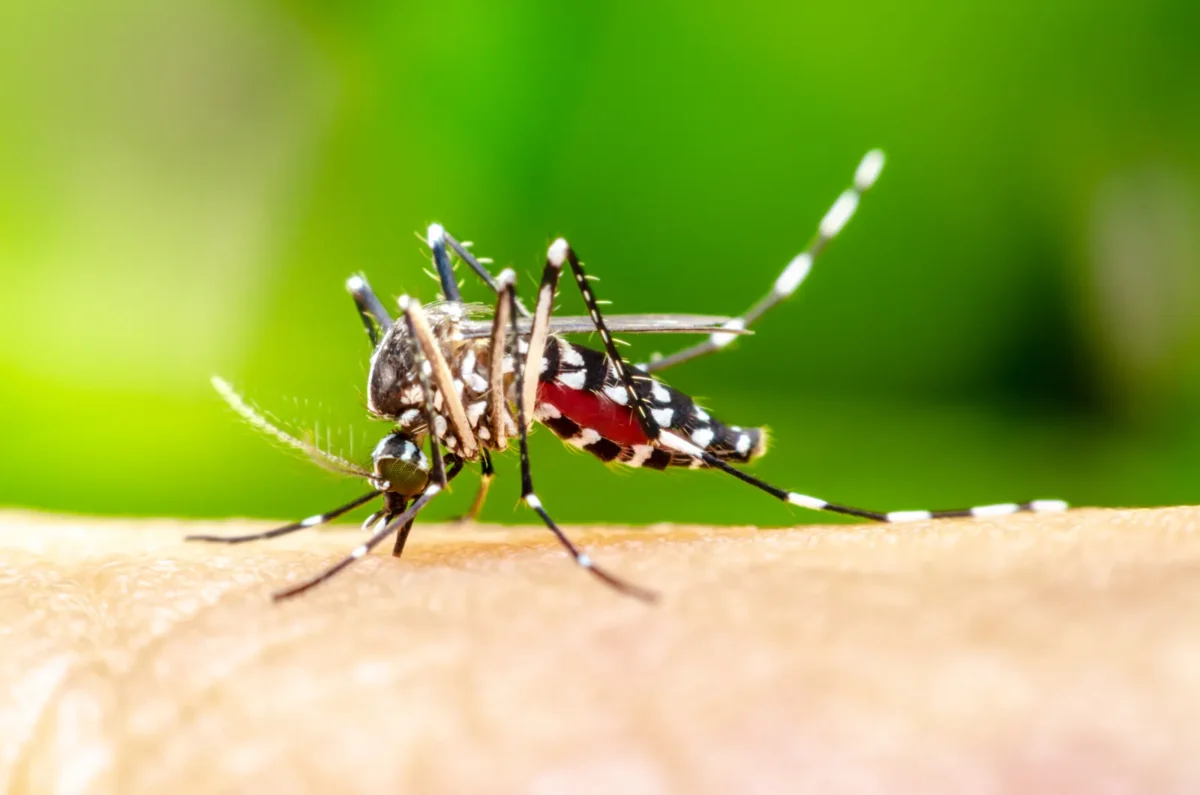
Spending time outdoors is great, but with that comes the risk of mosquito bites. If you find yourself frequently bitten by mosquitoes, it could be due to your scent or the colors of your clothes, recent research suggests.

“If you think you are a mosquito magnet, it’s probably the case,” said Jeffrey Riffell, a biology professor at the University of Washington who studies mosquito sensory systems, in a video released on the university’s website earlier this month. “Some individuals are bitten way more than others.”

Riffell and his team have been researching how mosquitoes locate their food sources. While male mosquitoes drink nectar from flowers for sugar, female mosquitoes drink blood to aid in egg-laying. “Mosquitoes are remarkably good at trying to locate a person to drink their blood,” Riffell explained. “They are vampires, and they’re very good at what they’re doing. Their eyes, their vision, their nose, everything about them is geared towards finding us and biting us.”

The team discovered that female mosquitoes find humans by following a trail of scent cues, including the chemicals humans emit from their skin and sweat, and the carbon dioxide from exhaling. Mosquitoes are also attracted to certain colors—they prefer red and black, but tend to avoid white and green, Riffell noted. Mosquitoes can also remember and return to people they find attractive after biting them, forming a positive association. However, they can also learn to avoid you if you try to swat them. University of Washington biology PhD student Melissa Leon Norena mentioned that mosquitoes can detect three types of sugar sources, one of which is fruit. Researchers are working on creating a scent that mosquitoes find irresistible. If successful, this scent can be laced with a toxin to kill the insects.

I am not sure I would want to wear a toxic perfume on my body. But maybe on clothes or just near by would work as well. Anything to help keep the little vampires of is good in my opinion.

Colorado’s Strangest Race

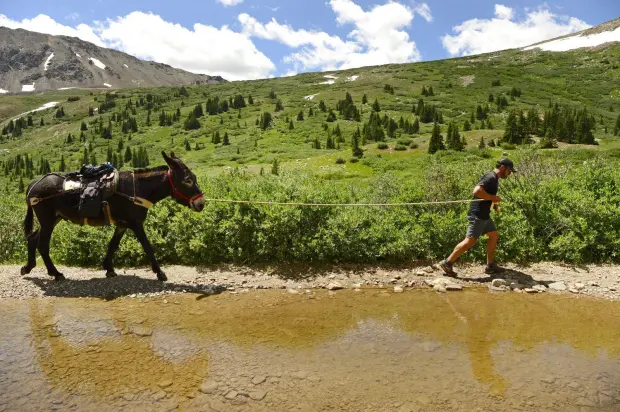
There are some unusual traditions, and one of them is pack burro racing, Colorado’s official state summer heritage sport since 2012. This sport began in 1949 with the World Championship Pack Burro Race, running from Leadville to Fairplay. The original 23-mile race over Mosquito Pass echoed the routes miners and their burros used before the railroads were built in the 1870s.

Pack burro racing harks back to mining days when prospectors raced to stake claims. To attract tourists and revive the local economy post-World War II, the Fairplay Chamber of Commerce organized the first event, drawing 21 teams. Each team, consisting of a human and a donkey, followed strict rules: the human held a lead rope, and the donkey wore a pack saddle loaded with traditional mining gear. Riding the burro is never permitted.

Only eight teams completed the inaugural race, with Melville Sutton and his burro, Whitey, winning a $500 prize. The race’s popularity grew, nearly doubling in participants by 1955. Today, Colorado hosts a Triple Crown of pack burro racing in Fairplay, Leadville, and Buena Vista, covering about 63 miles in total. The state offers ten races from Memorial Day through September, with other states like California, Arizona, and New Mexico also hosting races.

Runners aged 16 and older can race with their own donkey or rent one. The Triple Crown series starts in Fairplay during Burro Days, with races varying in distance and elevation. Leadville hosts its race the first weekend in August, featuring a loop around Ball Mountain or a route to Mosquito Pass. Buena Vista added a 13-mile race to its Gold Rush Days celebration in 1978.

Donkeys, capable of carrying 20 to 30 percent of their body weight over tough terrain, enjoy having a job. The challenge is convincing them to race. Once they understand the task, they develop a liking for it and will work hard if they trust their handler.